Instructor guide + student field record
Meet the buddies who build your everyday
Why the trades matter. It takes many different people to build and care for our world. Drawing, measuring, building, organizing, and solving problems can help you explore that work.

- Target age
- 10–12
- Lesson length
- 15 min
- Hands-on outcome
- Buddy connection
- Series
- Intro · 01 of 02
- See it
- Try it
- Connect it
- Explain it
- Find it
Who makes the places we use every day, and how am I already practicing some of their skills?
Hands-on outcome: Build a small shelter, then connect something you do to a skill, a Buddy's work, and someone it helps.
Learning objectives: By the end, students can name one character's role, connect a familiar activity to a relevant skill, and explain how that work helps another person. They can also describe why a building needs a team.
Materials + setup
Per pair: Six building blocks, one small piece of cardstock, paper, and a pencil.
Teacher: The character sheet (the crew line-up), a picture of a familiar home or school, and the character connections below. Display the sheet so students can point to each Buddy.
Discovery first. Career choice later. These activities introduce habits children can practice; they do not make a child a trained tradesperson or assign a future career.
15-minute run of show
- Build a shelter + why / how / what
- Meet the crew
- Find your Buddy connection
- One school, many helpers
- Exit challenge
Use the connection cards as quick visual prompts, not a script to read in full. The optional home activity is outside the 15-minute lesson.
Build it. But is it ready?
0:00–2:00 · Hook + purpose
"An imaginary toy needs a shelter. Use your blocks and cardstock to build somewhere it can fit underneath. You have 45 seconds!"
After building, ask: "You made a shelter! But if this were a real home, could someone move in yet?" Prompt students to consider water, warmth, lights, and a way inside.
"A building needs more than walls and a roof. It needs a team. Let's meet ours."
The 30-second pitch
"Everyone needs safe places to live, learn, and play. People make those places possible."
"Builders use their hands and minds together. They imagine, measure, build, solve problems, and help each other. You practice some of those same skills already!"
"Today, you'll meet the Lunch Bucket Buddies, build a tiny shelter, and discover how something you enjoy doing connects to work that helps people."
Students experience a small building problem before hearing career names. Their own model makes the need for other people and systems concrete.
Introduce the crew
"Some Buddies design and plan. Some build and install. Others organize the work or care for what is finished. Their jobs are different, but they need each other."
Architecture, surveying, contracting, and supervision are building-industry roles that work alongside the skilled trades.
Meet the crew
2:00–7:00 · Character connections
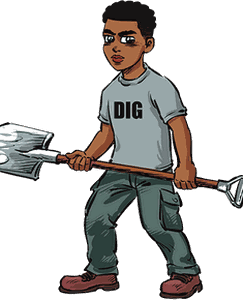
Eldridge the Excavator
Excavation
- Today:
- Shape a sandbox road and move sand with a toy loader.
- Skill:
- Plan where material goes and how ground should be shaped.
- Real work:
- Excavation workers prepare ground and dig spaces for foundations and utilities, helping a project get a sound start.
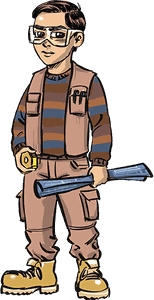
Amir the Architect
Architecture + design
- Today:
- Draw a dream clubhouse with room for friends and a doorway.
- Skill:
- Imagine how a space will work for the people using it.
- Real work:
- Architects design buildings and prepare drawings that help teams create useful spaces.
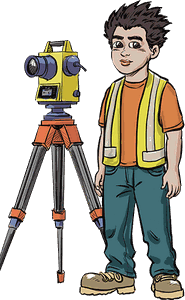
Salvador the Surveyor
Surveying + layout
- Today:
- Measure a pretend playground on paper and mark its features.
- Skill:
- Measure carefully and record locations.
- Real work:
- Surveyors measure land and establish locations and elevations so teams know where work belongs.
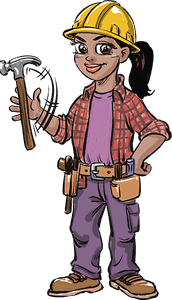
Carmen the Carpenter
Carpentry
- Today:
- Build a block fort with an open doorway and a supported roof.
- Skill:
- Think about fit, support, and connections.
- Real work:
- Carpenters build framing and install doors and trim, turning plans into spaces people can use.
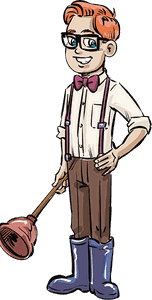
Pierce the Plumber
Plumbing
- Today:
- Pour water through a funnel into a container; notice why it spills if the funnel moves.
- Skill:
- Follow water's path and notice where it escapes.
- Real work:
- Plumbers install and repair water and drain pipes so people can wash, use bathrooms, and carry wastewater away.
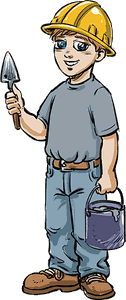
Connor the Concrete Contractor
Concrete contracting
- Today:
- List supplies for a group model, choose steps, and divide work.
- Skill:
- Organize people, materials, and the order of tasks.
- Real work:
- Contractors coordinate construction so the right people and materials arrive when needed.
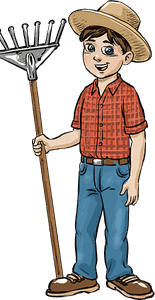
Randy the Landscaper
Landscaping
- Today:
- Care for a plant; notice dry soil or changing leaves.
- Skill:
- Observe living things and respond to their needs.
- Real work:
- Landscape professionals build and maintain outdoor spaces for play, gathering, and enjoying nature.
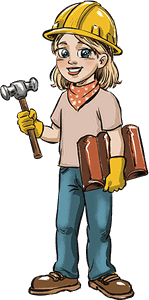
Raelyn the Roofer
Roofing
- Today:
- Overlap cards to cover gaps in a model roof.
- Skill:
- Think about how layers protect the space below.
- Real work:
- Roofers install and repair coverings that help keep rain outside and buildings dry.
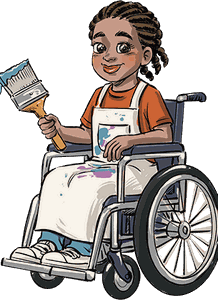
Pemba the Painter
Painting + finishing
- Today:
- Prepare and paint cardboard, covering surfaces and keeping edges neat.
- Skill:
- Prepare surfaces, protect nearby areas, and work with care.
- Real work:
- Painters prepare and coat surfaces to protect materials and make spaces finished and welcoming.
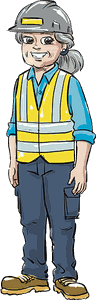
Mrs. Hayes the Supervisor
Site supervision
- Today:
- Help a group follow directions and check its next step.
- Skill:
- Communicate, notice problems, and support teammates.
- Real work:
- Site supervisors oversee daily work, coordinate crews, and check safety, quality, and progress.
Role distinction: Connor coordinates the overall project; Mrs. Hayes focuses on daily site work. These responsibilities can overlap.
Two more teammates
- No Buddy yet
Electrical
Electricians
Connecting a battery-powered light kit practices following a path and checking connections. Electricians install systems that power lights and equipment.
- No Buddy yet
HVAC
Heating, cooling + air
Folding a paper fan and testing airflow practices comparing changes. HVAC technicians install and service heating, cooling, and ventilation systems.
Electrical and HVAC don't have named Buddies yet. The activities above are connections, not additional in-class stations.
Find your Buddy connection
7:00–10:00 · Try it + explain it
Each student chooses one Buddy, or the electrical or HVAC team, and fills in the field record. Partners explain their connections to one another.
"What part matches the work: measuring, planning, making, checking, caring, or working together?"
Accept more than one sensible connection. Building forts might connect with Carmen, Amir, Raelyn, or Connor.
"I like making water paths with funnels. I practice following where water goes. Pierce uses that thinking to find a leak. That helps people keep water where it belongs."
"I like drawing clubhouses. I practice planning spaces. Amir uses that thinking to design buildings that work for people's needs."
One school. Many helpers.
10:00–13:00 · Connect the crew
Show the school picture. Ask: "A neighborhood needs a new school. Which Buddies could help, and what would children need them to do?"
| What the school needs | Who helps |
|---|---|
| Useful rooms and shared spaces | Amir, with input from the people who will use the school |
| Accurate locations and prepared ground | Salvador and Eldridge |
| Framing, doors, and a weatherproof roof | Carmen and Raelyn, alongside other crews |
| Bathrooms, lights, and comfortable classrooms | Pierce, electricians, and HVAC technicians |
| Finished surfaces and outdoor spaces | Pemba and Randy |
| Organized people, supplies, and daily work | Connor and Mrs. Hayes |
This is a team map, not a complete construction schedule.
Work matters because people matter
Teamwork debrief · within 10:00–13:00
"Could one Buddy do all of this alone? What happens when teammates don't tell each other what they need?"
Make it concrete: "Pierce needs room for pipes. Carmen needs to know where those pipes belong before parts of the building get closed up. Talking and planning together helps both of them do good work."
People need each other. Different skills help a whole community. Good work serves someone. A working sink helps a child wash their hands. Care matters. Measuring, checking, and communicating affect the people who use what we build.
Exit challenge: who helped your day?
13:00–15:00 · Retrieval + reflection
Students name one Buddy, explain why that work matters, and identify one skill they can practice. Invite two students to share. Use the prompts on the field record.
"Someone planned it. Someone built it. Someone keeps it working. You can start learning those skills today."
Success looks like
Listen for an accurate role, a sensible connection to an everyday activity, and an explanation of whom the work helps. Assess reasoning rather than memorization of every character name.
Optional home connection: spot a Buddy's work
Find three examples in a familiar room, school, park, or photograph. Record what you notice, which Buddy it connects to, and how it helps someone. A sink connects to Pierce; a doorway to Carmen and Amir; a planted area to Randy. Observe and explain. No tools or repairs needed.
Support: Students may point, draw, dictate, or explain aloud. Use the character sheet for names. No home photos or special supplies are required.

Printable student field record
My Buddy connection
Name:Date:
I like to...
That helps me practice...
My Buddy or trade team uses that thinking to...
That helps people by...
Draw your connection
Exit challenge
One Buddy whose work helps my day is
Their work matters because
One skill I can practice now is